The Fire Does Not Stop at the Border
By: Lisa Hayes for Confluence Daily
The international consequences of Trump’s environmental policy cannot be reduced to America’s absence from climate conferences or another embarrassing photograph of an empty chair.
The United States is not merely declining to lead. It is changing the physical conditions under which other countries must survive.
For more than a century, the United States built extraordinary wealth by burning coal, oil, and gas. It remains the largest historical contributor of fossil-fuel carbon dioxide in the world. The carbon from that development did not remain suspended over Pittsburgh, Houston, or Detroit. It accumulated in a shared atmosphere.
Its consequences are now shared too.
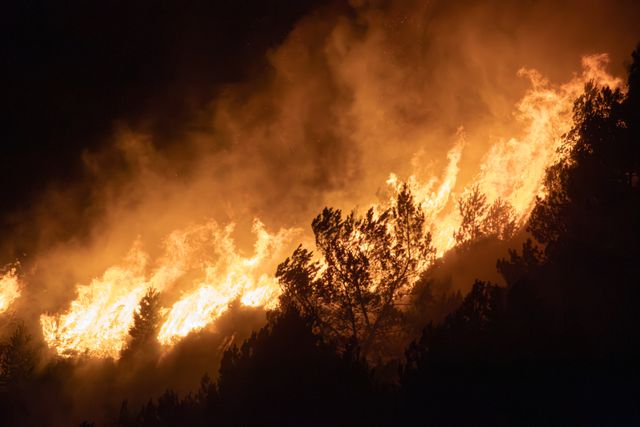
A hotter atmosphere draws more moisture from soil and vegetation. Snow melts earlier. Heat waves become more intense. Droughts deepen. The safe window for prescribed burning narrows. Forests, shrublands, peatlands, and grasslands become more combustible.
The ignition may come from lightning in Canada, a power line in Chile, agricultural burning in the Amazon, an arsonist in Greece, or a cooking fire in South Africa. The match is local. The conditions surrounding it are increasingly global.
This is where the usual language of climate responsibility becomes dangerously polite.
Trump’s policies are not merely “setting back American climate progress.” They are helping create more dangerous fire conditions in countries whose people had no vote in the 2024 United States presidential election.
The United Nations Environment Programme estimates that the second American withdrawal from the Paris Agreement effectively adds approximately 0.1 degrees Celsius to projected global warming. A fraction of a degree sounds insignificant only to people unfamiliar with scale. Applied across the atmosphere, oceans, forests, and ice sheets of an entire planet, it is an enormous amount of additional energy.
There is no exclusively American tenth of a degree.
It appears in Canadian forests. Mediterranean heat waves. Mexican reservoirs. Patagonian drought. Australian bushland. Arctic tundra.
The Trump administration has simultaneously canceled international climate-finance commitments intended to help vulnerable countries prepare for precisely these conditions. That financing supports adaptation: weather monitoring, early-warning systems, resilient infrastructure, land management, emergency planning, water security, and disaster response.
Its disappearance will rarely produce a photograph.
Instead, a weather station will not be installed. A prescribed-burn program will remain understaffed. A rural fire brigade will continue using obsolete equipment. An evacuation warning will arrive late. A community destroyed by one fire will rebuild with the same materials because safer ones are unaffordable.
Months or years later, when the landscape burns, the disaster will be described as natural.
This is how wealthy nations hide policy inside weather.
American retreat also gives permission to every government and corporation looking for an excuse to postpone action. If the country most responsible for historical emissions can declare climate obligations unfair, why should a developing country constrain its own growth? If the United States expands drilling while demanding restraint elsewhere, why should anyone believe climate agreements are anything more than a hierarchy disguised as cooperation?
Trump’s climate policy exports more than carbon.
It exports permission.
Permission to delay. Permission to extract. Permission to treat short-term profit as national strength and planetary consequences as an accounting error. Permission to insist that every country is alone until the moment its firefighters, aircraft, military, or money are needed somewhere else.
But fire has already exposed the absurdity of that worldview. When British Columbia burned this summer, personnel arrived from Mexico, Australia, and France. Smoke crossed borders. Aircraft crossed borders. Firefighters crossed borders.
Only American responsibility was expected to remain neatly contained.
It does not.
The fire may begin in another country. That does not mean the United States had no hand in making the world around it burn.
 Lisa Hayes is a life coach, writer, and editor of Confluence Daily, specializing in social issues, political issues, and mental health. Her work has appeared in publications like Huffington Post and Real Simple. She is also the Communications Director for a local fire department in Mexico and runs a life coach training program called The Coaching Guild.